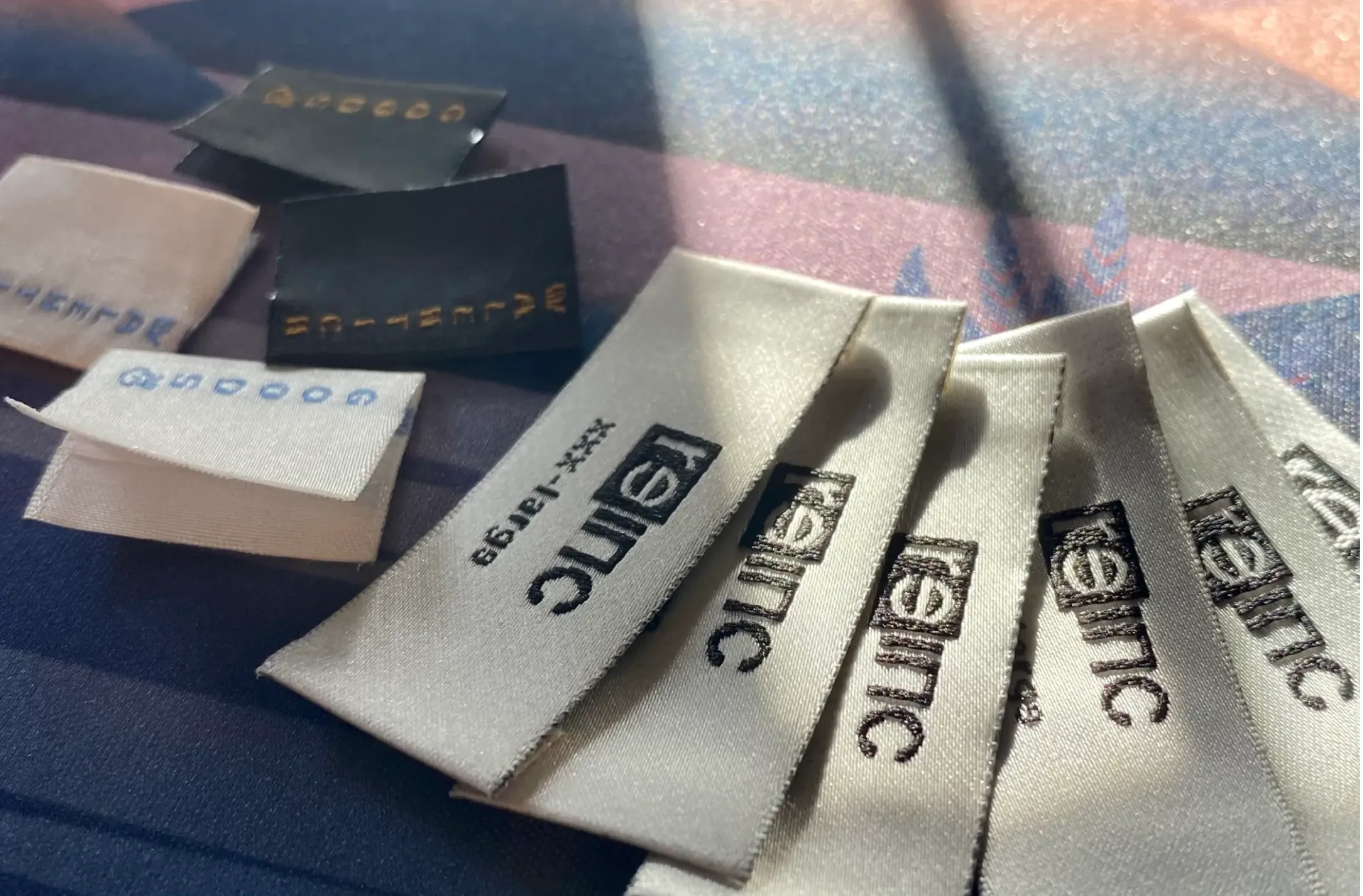
Visible size and cut size
Visible size describes the area you expect to see after the label is folded or sewn into the garment. Cut size describes the piece before those operations. These measurements can differ, and confusing them can leave the logo too close to a seam or fold.
Write both dimensions on the artwork where folding is required. Mark the orientation of the finished label as it will be seen by the wearer or customer.
Flat labels
A flat label has no pre-planned centre or end fold. It may be stitched around its perimeter or caught into a seam depending on the garment. Leave adequate space around important artwork for the chosen sewing method.
Centre fold
A centre-fold label is folded across its middle. It can have a front and back face with the cut ends held in a seam. Artwork must be oriented correctly on both faces. The total cut length includes both faces and the specified seam allowances.
End folds
End-fold labels have turned ends that can provide sewing areas at opposite sides. Fold allowance depends on material, dimensions and how the label will be attached. Do not apply one standard allowance to every order without checking it.
For example, a label with a 40 mm visible width and two agreed 5 mm end folds would have a 50 mm total width. That example explains the arithmetic only; the practical allowance still needs confirmation.
Safe areas and approval
Keep logos, text and other important details away from fold lines and stitch zones. Ask the garment maker how the label will be sewn in. A suitable label can still look wrong if the garment seam covers the intended visible area.
Approve the cut dimensions, visible dimensions, fold positions and orientation together. Send a garment placement photo if the construction is unusual.
Need advice for your artwork?
Send the product type, dimensions, quantity and delivery country. Our team can discuss practical options for your project.
Discuss my project ↗